Nino CRM
AI-copiloted CRM for public adjusters — built solo, used daily by the operations team.
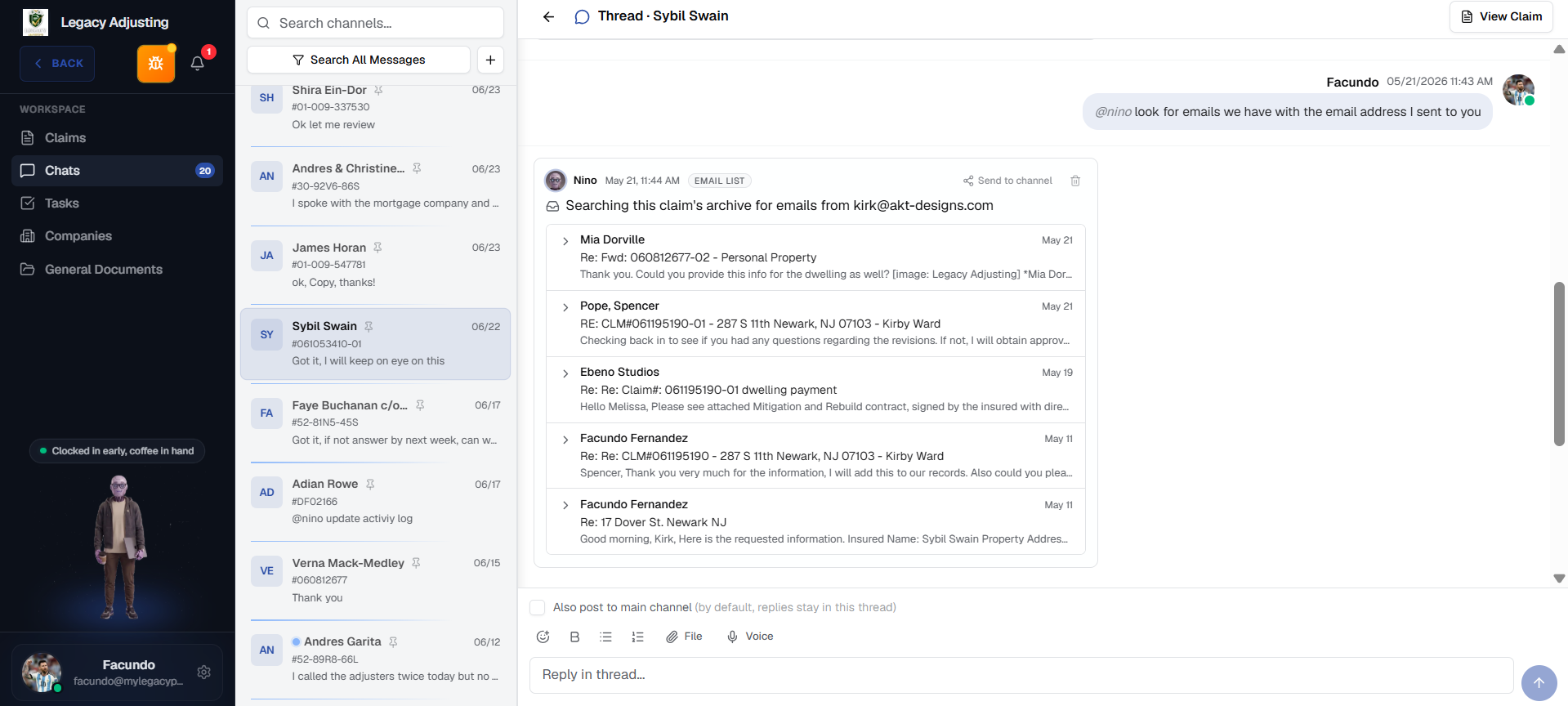
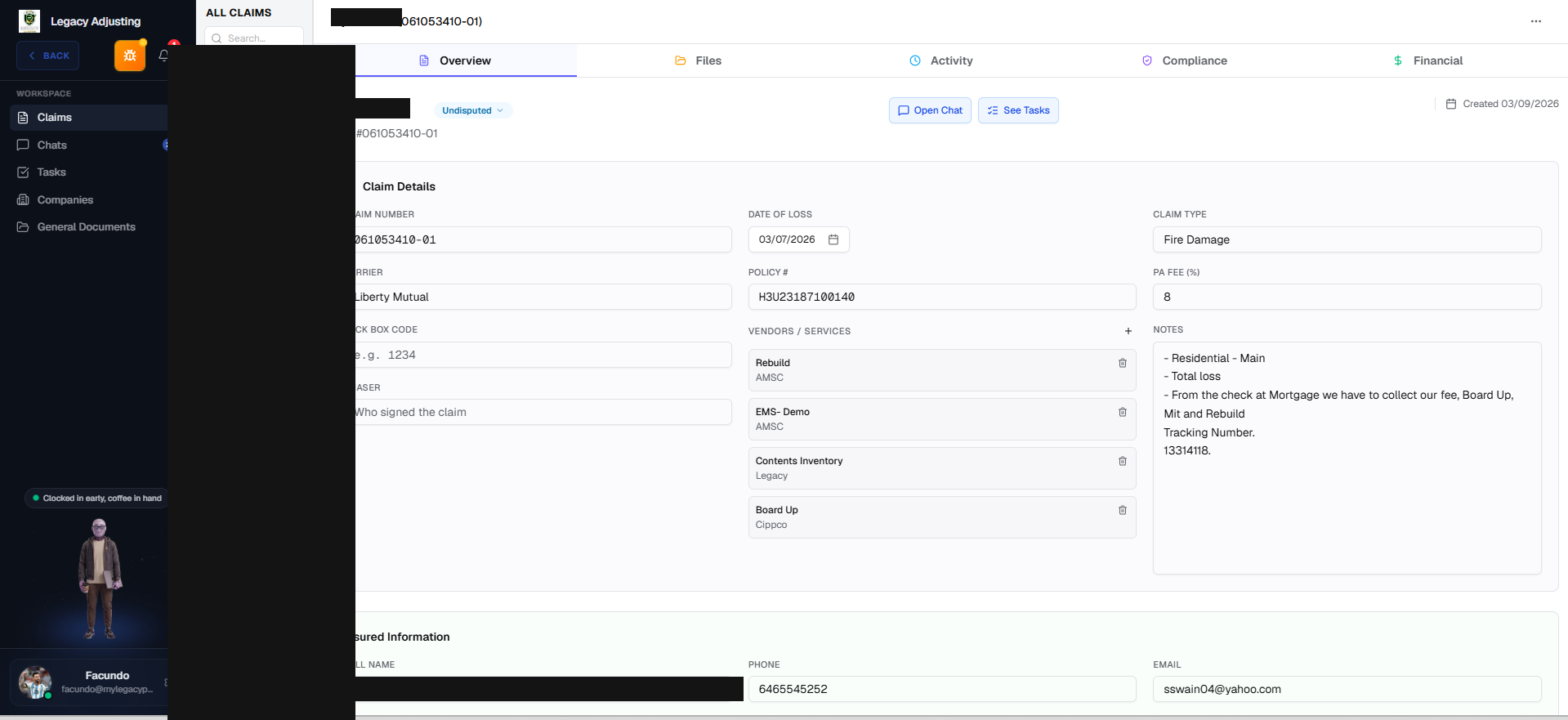
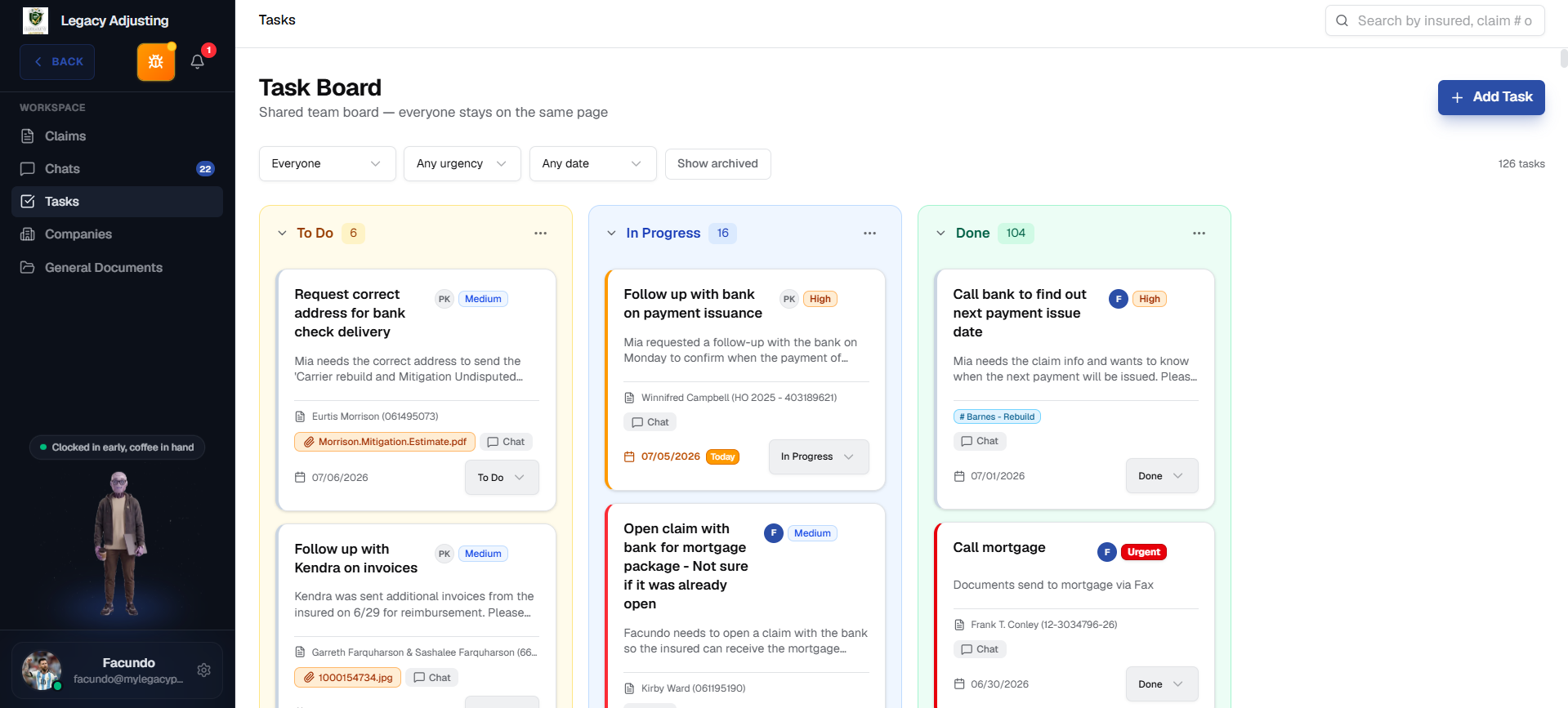
I'm the Operations Manager at My Legacy Public Adjusters, a 19-person public adjusting firm that represents policyholders in claims against insurance companies in the US. Nino is the core tool of the operations team (4 people), who use it to manage 19 active large-scale (fire) claims through their entire lifecycle.
Our operation was fragmented across four disconnected tools: Claim Wizard as a CRM — an overwhelming interface, hundreds of unnecessary features, no AI, generic and costly (~$349/mo). On top of that, Google Chat for communication (disorganized, information got lost), Trello for tasks (no real day-to-day oversight), and Notion for call notes (isolated from the claim they belonged to).
Opening a new claim — signing the document, creating the client in the CRM, opening the chat channel, uploading documentation, and extracting data — took 10 to 20 minutes of manual work, with a high error rate. Entering a wrong data point or forgetting one was routine, and in insurance claims, a wrong data point has real consequences. Notes for each claim depended on each person's memory and discipline. And outside office hours — nights, weekends — the operation simply stopped.
I lived this chaos firsthand every day, and heard the same complaints from my coworkers.
Opening a claim: from 10–20 manual minutes to 1–2 minutes with the copilot.
We had already paid for two CRMs in the industry (Claim Wizard and Claims Titan). Using them taught me what they did well and, above all, where they failed our real workflow. Generic CRMs forced us to adapt to them; I wanted the opposite. With AI tools for building, the build vs. buy calculation changed: building something exactly tailored no longer required an engineering team.
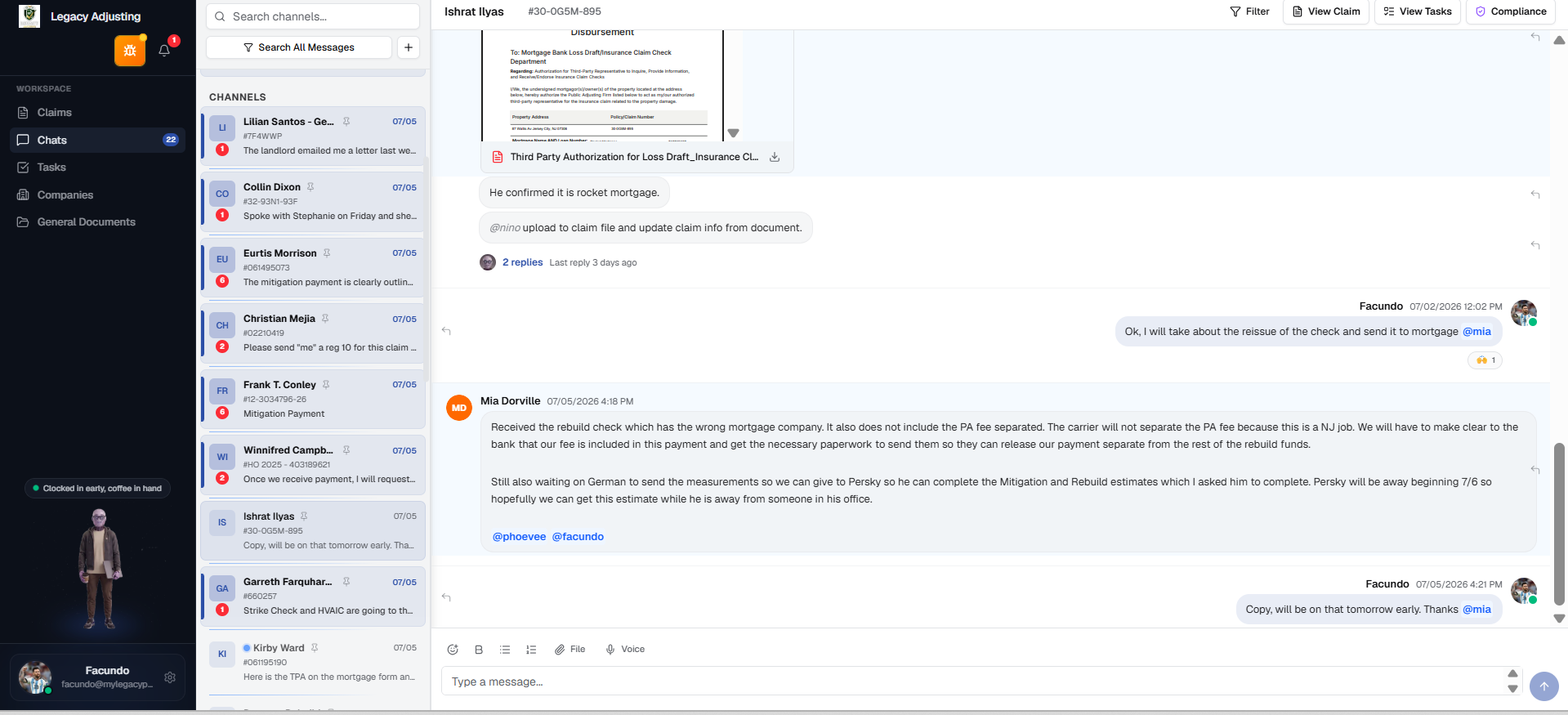
Chat as the central interface, one channel per claim
Each claim lives in its own channel: all the conversation and info for that case is in one place, and Nino lives right there — invoked from the chat where the team already works, instead of forcing them to another screen.
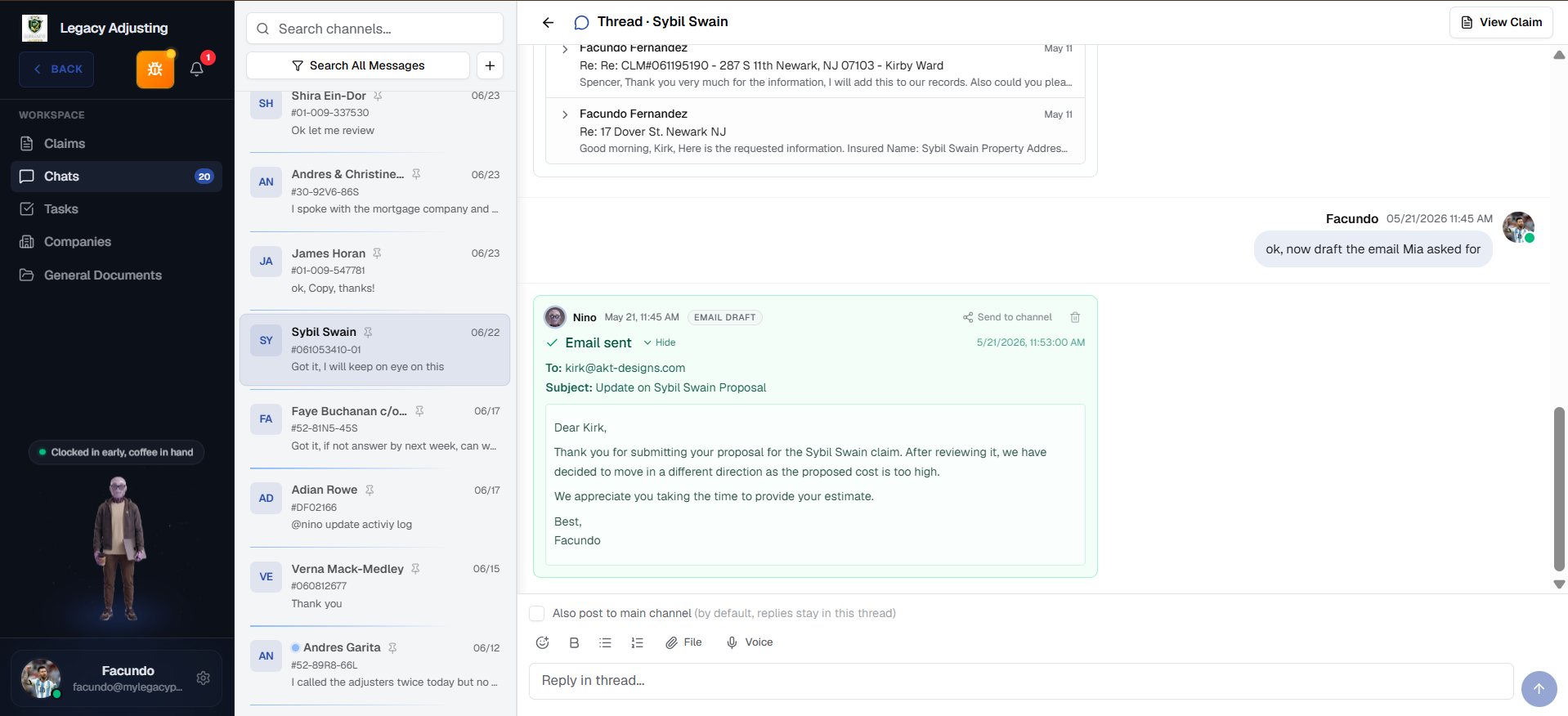
AI with human oversight
One click to confirm, zero actions behind the user's back. Human oversight reduces errors and hallucinations — and in a legal industry like insurance, a wrong data entry has real consequences. The copilot proposes; the human confirms.
The checklist I built differently than requested
The request was a general claims checklist. I made it per-case instead, because processes aren't the same across claims — a generic checklist would have been useless exactly in the atypical cases where it's needed most.
Cost trade-off
Having decided not to commercialize Nino, I dropped Unipile (US$55/mo) and replaced it with Google's free test version, training the team on the weekly 3-click re-login. Less elegant, zero cost: the right call for an internal product.
Multilingual by design
Responds in English or Spanish, whichever the user needs.
From idea to the team's first real use: 2 weeks.
Four more weeks of full-time iteration — bugs, improvements, new features — until a complete product by week 6. I keep iterating on it with team feedback. Adoption was immediate: centralizing tasks and the cost savings sold themselves.
I wouldn't invest in software again without testing it thoroughly first. We paid for tools we ended up underusing or abandoning; today, before spending a dollar on a tool, I'd validate it will actually get used.
I built Nino to solve my team's problem, not to sell it. The goal was operational, and it delivered: it replaced ~$4,200/year in software and eliminates errors every day. Commercializing it is a different decision I haven't made — it would require validating external demand, resolving IP ownership with my employer, and a sales-and-support commitment that isn't my priority right now.